
February 23, 2026 •Johnson County CASA

If you and I were sitting across from each other at a coffee shop in Johnson County, and you asked me what a CASA volunteer actually does, I’d probably say this:
You stand in the gap for a child.
But here’s something people don’t always realize. Standing in the gap does not mean standing against parents. In many cases, it means standing with them.
Family reunification is the goal in most child welfare cases. When it is safe and appropriate, the court wants children to return home. And as a CASA volunteer in Johnson County, Indiana, you become part of that process in a powerful, steady, life changing way.
Let’s talk about what that really looks like.
Family reunification is the process of helping a child safely return home after being removed due to abuse, neglect, or unsafe conditions.
Here in Johnson County, cases are heard through the Indiana juvenile court system. Judges rely on clear, objective information to make decisions about a child’s safety and long term stability.
That’s where CASA comes in.
In Indiana, CASA programs operate under the umbrella of Indiana State CASA, with local programs serving counties like ours. Volunteers are appointed by the court to represent the best interests of children involved in abuse and neglect cases.
And often, the best outcome is a safe reunification with their parents.
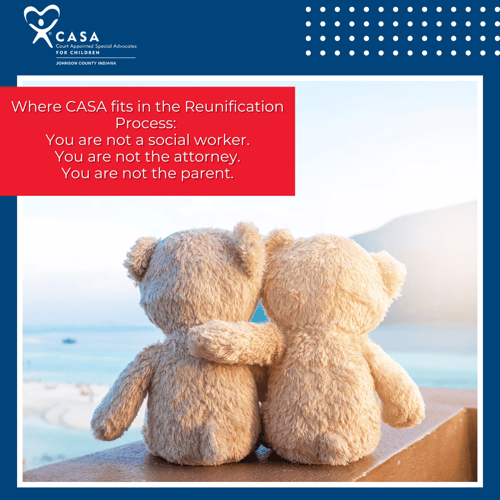
You are not a social worker.
You are not the attorney.
You are not the parent.
You are the consistent adult whose only job is to focus on what is best for the child.
Here’s how that plays out in real life.
This surprises a lot of people.
CASA volunteers talk with parents regularly. You might meet them at supervised visits, attend family team meetings, or speak with them before court hearings.
Instead of approaching parents with suspicion, you approach them with curiosity and respect.
You might say:
“Help me understand what you’re working on right now.”
“What support would make this easier for you?”
Many parents in the system are navigating addiction recovery, mental health treatment, housing instability, or generational trauma. They are often overwhelmed and scared.
Your calm, steady presence matters.
If a parent is working toward reunification, there are usually specific steps required:
As a CASA volunteer in Johnson County, you help track whether those services are happening and whether they’re effective.
You don’t police. You observe. You gather facts. You speak with providers. You document patterns.
Then you provide clear, objective reports to the judge.
Judges depend on CASA volunteers because you are independent. Your only priority is the child’s safety and long term stability.
Let’s say a parent is doing the work. They’re attending treatment. They’re sober. They’ve secured stable housing in Greenwood or Franklin. They’re showing up consistently for visits.
You get to tell that story in court.
You advocate for increased visitation.
You recommend trial home visits when appropriate.
You help ensure services are in place so the child transitions safely.
Reunification should not drag on longer than necessary. Children need stability. If it is safe, returning home sooner rather than later can prevent long term emotional harm.
Your voice can help make that happen.
And here’s the hard part.
Sometimes, despite services and time, it is not safe for a child to return home.
When that happens, the court needs clear, child focused recommendations. Not emotionally reactive opinions. Not punishment for parents. Just facts, patterns, and safety concerns.
As a CASA volunteer, you are trained to assess the whole picture. You are supported every step of the way by supervisors and staff. You are never left to make these decisions alone.
Your role is to ensure the child’s long term safety is never overshadowed by pressure to close a case quickly.
Why This Matters So Much in Johnson County
Right here in Johnson County, Indiana, children enter the court system through no fault of their own.
They may move between placements.
They may change schools.
They may feel uncertain about where they belong.
Reunification, when done safely, restores connection. It can heal families. It can break generational cycles.
And you get to be part of that.
You get to be the steady adult who shows up to every hearing.
The one who knows the child’s favorite subject in school.
The one who notices when visits are improving.
The one who asks the hard questions when something feels off.
That consistency is powerful.
Imagine sitting in court in Franklin, Indiana.
The judge reviews reports. The Department of Child Services presents updates. The attorneys speak.
Then your report is considered.
You share that the parent has completed treatment. The home is stable. The child expresses feeling safe. Visits have been consistent and appropriate for months.
The judge orders reunification. That moment is not about you. It is about a family being restored safely. But you were part of that story. And that stays with you.
If you are thinking, “I care deeply about children, but I am not sure I know enough,” let me reassure you.
You receive comprehensive training.
You have a supervisor guiding you.
You are part of a team.
You do not need a law degree. You do not need a social work background. You need compassion, reliability, and the courage to speak up. That’s it.
Here is something many new volunteers do not expect.
Parents often express gratitude for CASA volunteers.
Why?
Because you listen.
Because you treat them like human beings.
Because you recognize their efforts when they are trying.
You are not there to judge their past. You are there to focus on the child’s future.
That perspective builds trust.
If you live in Johnson County and you care about children navigating the court system, this may be the role you have been looking for.
It takes just a few hours a month.
It requires commitment, yes.
But it also offers something rare.
The chance to directly influence the outcome of a child’s life.
Every child deserves a champion.
You could be that voice in court.
You could help guide a child to a safe and stable home.
And sometimes, that home is with their parents
CASA volunteers advocate for the best interests of the child during abuse and neglect cases. When reunification is the goal, they monitor parental progress, assess safety, and provide objective recommendations to the judge.
Yes. CASA volunteers often communicate with parents, attend visits, and participate in family meetings. The goal is to understand the full picture and support safe outcomes for the child.
In many cases, yes. The court prioritizes reunification when it is safe and appropriate. However, the child’s long term safety and stability always come first.
Most CASA volunteers dedicate approximately 8 to 10 hours per month. This includes visits, phone calls, documentation, and court appearances.
No. You receive training and ongoing supervision. You do not need a background in law or social work, just a commitment to advocating for children.
You can begin by reaching out to your local CASA program serving Johnson County. They will guide you through orientation, training, and the application process.